Cost of poor service - the economic truths
By Paul Linnell
The success of a business, a government department or a public sector body, is either measured in financial terms, or limited by financial budget constraints. But a disconnect often occurs with investment decisions because although customer satisfaction, loyalty and advocacy is key to any organisation’s success, it is seldom expressed in financial terms.
The intuitive link between customer satisfaction and loyalty is one that can be hard to quantify. The fact that even satisfied customers defect has done more to drive companies to inaction than it has to demonstrate the clear business gains that can be derived from maximising customer satisfaction and harnessing the link between customer and employee value, satisfaction, loyalty and profit.
CTMA has found that
dissatisfaction amongst customers and employees has a significant and measurable impact on financial outcomes for the organisations. For businesses it has a direct impact on growth and places revenue and profit at risk. For public sector organisations, poor service can significantly increase costs and sometimes lead other negative social and community outcomes.
By quantifying this impact, an organisation can prioritise their investments in service and establish a financial framework for customer-driven value creation.
The cost of customer dissatisfaction
There are five key economic truths that quantify financial return on investments made to customer service. Organisations wishing to improve their corporate bottom-line must factor these into investment decisions and growth strategies: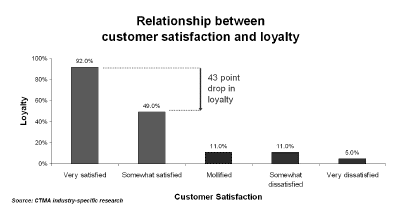
- As satisfaction levels drop, loyalty drops faster
- Problems drive customers away
- Many more customers experience problems than you think
- Unhappy customers spread the word!
- Effective customer service and response pays
As satisfaction levels drop, loyalty drops faster
There is a significant drop in loyalty between “very satisfied” and “somewhat satisfied” customers - sometimes as much as 50%. A dangerous policy in many organisations is to ignore this fact and simply add together the percentage of “very satisfied” and “somewhat satisfied” customers to get a “better satisfaction score”.
Problems drive customers away
Customer loyalty varies from one industry to another but there is typically a 25% drop in loyalty among customers who experience a problem. In revenue terms this can be the equivalent of losing some, or all, of the revenue from one in every four customers who have experienced a problem.
More customers have problems than you think
For many organisations, the only measurement of problem-experience comes from their complaints department. Research shows that as many as 50% of your customers may actually be experiencing problems, even though only 5% of those may complain to your complaints department. As many as 95% of customers who experience a problem may say nothing to you at all.
Unhappy customers spread the word!
Our research confirms that customers typically to tell twice as many people about a bad experience with customer service than they do about a good one. Depending on the industry, between 5 and 10 people are told about an bad experience. Today, the dangers of negative word-of-mouth have been greatly amplified by the Internet and the power of social networks.
Effective customer service and response pays
CTMA’s research also confirms the importance of effectively responding to customers when they do complain. Customers can be very demanding but, with an effective response, it is still possible to obtain a more loyal customer afterwards - than you had before they experienced the problem!
Customer dissatisfaction with public sector services
 CTMA has worked closely with a number of public sector bodies to help
measure and manage service quality and improve customer satisfaction.
The challenge for central and local government is often to justify
investment in service improvement when their customers in many cases
have nowhere else to go for the services they provide.
CTMA has worked closely with a number of public sector bodies to help
measure and manage service quality and improve customer satisfaction.
The challenge for central and local government is often to justify
investment in service improvement when their customers in many cases
have nowhere else to go for the services they provide.
However, when the impact of poor service is measured in terms of its
impact on the strategic outcome objectives of the public sector agency,
the “cost” of poor service can be assessed in the context of the
investment required to improve it.
For example, much of the work done by local councils is to respond to
customers’ requests for service to address the ongoing maintenance
of public infrastructure and amenities. For these types of
requests our research has identified four key factors that can lead to
escalated service costs and reduced support and advocacy from
customers. These factors are:
- Not acting on problems
- Not acting quickly enough (or as promised)
- Not acting correctly
- Not being informed of problems
By adopting an approach to customer experience measurement and
service quality improvement, a transformation can occur that enables
informed decisions to be made that maximise strategic and tactical
returns on service quality investments. In many cases, savings can be
achieved and significant improvements made without incurring any
additional service costs.
Request a copy of our local government working paper “Using satisfaction measurement to Improve Service and Reduce Costs”
and learn more about the costs of poor service in local government and
how to turn customer experience measurements into management actions.

The cost of employee dissatisfaction
 Employee dissatisfaction can also be measured in financial terms. When employees experience problems and concerns with their employer or their job it can have a serious impact on:
- Productivity and the productivity of their colleagues
- Product and service quality
- Customer satisfaction
- Attendance
- Career ambition
- Staff retention
- Health and safety
Since customer satisfaction and employee satisfaction have such a direct influence on each other, when correctly managed, this can have a positive influence on profitability and growth.
Conversely, endemic dissatisfaction can quickly spread and lead to
increased costs, reduced profits and corporate decline.
© CTMA New Zealand Ltd.
How we can help
 CTMA’s portfolio of consulting and research services is dedicated to helping organisations address these risks and help turn customer feedback and customer satisfaction measurement into management actions. We work internationally with organisations to help them achieve business success, reduce risk and build customer loyalty and advocacy.
Upcoming events:
From time-to-time we also run workshops, masterclasses, roadshows and
online training courses to help organisations accelerate their progress
towards being tuned success. Please check
here for information
about our upcoming public
events.





 Using satisfaction measurement to Improve Service and Reduce Costs

