
|
Previous topics:Please feel free to browse through our previous topics below in “blogological order” or, if you prefer, check-out the categorised list on the right panel.
How important is the brand? It shouldn’t take a major re-branding exercise to wakeup the market about customer experience and customer loyaltyThis week in New Zealand, ANZ National Bank
announced that that after almost ten years of operating
“ANZ” and “The National Bank” as two separate brands in New
Zealand, the two will now be brought together as “ANZ”. Suddenly, the “brand stickiness” of a well-established and valued brand has been removed from the equation of loyalty and advocacy. The hot topic at the water cooler, supermarket checkout and bus stop is: “Which bank do you bank at?”, “Would you change to another bank?”, “How good have you found their service?” Whatever their current persuasion, many banking customers in New Zealand are now reflecting on what it is that is actually important to them when choosing a bank. Is it the colour of the logo and brand? Is it the service they provide to their customers? Or, is it the cold hard numbers of interest rates and bank charges? The question of banking loyalty is suddenly on everyone’s agenda – an agenda that will no doubt bring risks to some banks and opportunities to others. But the clear advantage will go to those who know their vulnerabilities and are able to take actions to address them. For banks, keeping existing customers and winning new business will depend more than ever on service and great customer experiences. Our research in retail banking already shows that the problems customers experience when banking, and the way many New Zealand banks handle customer complaints, can place between 8% and 12% of their annual profits at risk. I’m really looking forward to the findings from this year’s study to see how this news may have impacted the customer retention dynamics of banking in New Zealand. What about you? Will this change the place you bank? What about your business? When did you last take a really hard look at what it is that keeps your customers coming back for more – and what is it that might be driving them away?
Measuring and Managing Success Asking your customers the right questionsA popular topic for discussion in the real-world and on-line recently has focussed on - “What questions should I ask in a customer satisfaction survey?” There are a great many reasons why organisations choose to survey their customers - so before spending a fortune on research it is important to first ask a question of yourself. “What am I trying to achieve with my customer survey?” Your answer to this question can have a huge impact on deciding what to ask your customers and how to analyse the results. For example:

Done correctly, this doesn't necessarily mean that it's going to be more expensive. In fact - far from it. This approach will normally provide you with a positive ROI. By identifying and addressing the problems your customer experience you can typically get multiple benefits. You can:
Anyway, back to the question of questions. The questions should be relevant to the customer’s experience, comprehensive in terms of their relationship with you or the interaction they have had with you, and yield results at the level at which you can take remedial actions. The questions you ask should directly relate to key parameters of the service process that the customer experienced, and ones where you have influence to improve. For example: "Did the service engineer arrive on-time?", "Was the problem resolved quickly?", "Did he/she provide advice on how the problem might be avoided in future?" etc. To identify management actions and set priorities you’ll also need to measure the performance of each of these parameters and the impact that each has on overall advocacy and loyalty to your company. Where we have worked with organisations to adopt these performance management methods there have been real and measurable improvements for their businesses and secondary benefits from the improved morale of managers and staff as their workload becomes less cluttered solving problems. So, don't ask your customers questions to get the answers you want to hear - ask them the questions that will help your business succeed.
Measuring and managing success Local government: Building consents - problems reduce and satisfaction improvesAlthough building consent and inspection services continue to place significant demands on local councils, we are seeing evidence that the investment made by some councils during the past few years to improve service has begun to pay-off. Since 2007, our annual customer experience study of building consents and inspection services in New Zealand has been helping participating councils identify sources of customer dissatisfaction and set service improvement priorities. The study has helped participating councils to almost halve the percentage of customers who experience problems with the building consent process and shows that customer satisfaction at participating councils has improved at more than twice the rate of other councils. Customer SatisfactionFor participating councils, the average index of overall customer satisfaction shows an improvement of 23 index points since 2007. Responses from customers of other councils, suggest that their service improvement initiatives may now be falling behind.
Problem ExperienceAmongst councils that have participated in the annual study there has been an average reduction in problems of 33 percentage points since 2007. However, responses from customers of other councils suggest that the steady reduction of problems seen between 2008 and 2009 might now be drifting upwards again.
A paper is available summarising the finding of this annual study and has been updated with finding from 2010. The study runs from September to December each year.
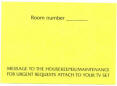
Hotel: Making it easy for customers to complainIf we don’t hear about the problems our customers experience, we don’t get the chance to put things right. We all know from personal experience that it is not easy to make a complaint. From our own research we have learned that some of the most common reasons customers give for not contacting a company about the problems they experience are:
This really simple and inexpensive device makes it easy for customers to report a problem and also easy for the hotel to take action. It also gives a clear message that the hotel actually wants to hear from them and has a process for putting things right. Wonderful!
Local government: Improve service and reduce costs
In the public sector it can sometimes be quite a challenge
to be calculate cost-justification for service improvement. But
one of our local government clients has recently shown just
one of the ways that customer satisfaction can be a
financial benefit in the public sector - as well as making
good sense for business. Through their customer experience measurement programme they have been getting an ongoing measure of service performance that helps them identify service failures and monitor the performance of their internally and externally resourced service delivery processes. The real win for this local council was that before they were routinely closing the loop with their customers, various process and system failures, and (dare I suggest) human factors, were contributing to delays and (in some cases) to the non-actioning of customer service requests. Many of these response delays were leading to customers needing to call back and repeat or escalate their requests. By identifying the specific request types, processes, systems, departments, service crews or contractors that were involved in each service failure, the programme has helped the council reduce their service request call-handling demand in their call centre by a full 13%. In performance terms their work to improve their services has helped them reduce prematurely-closed service requests by 30% and increase their customer satisfaction by 10%. Hats of to their team - great savings for the council and a fantastic example of turning customer experience measurement into management actions!
Retail banking: Customer retention at risk
|
|||||||||||||||||||||||||||||||||||||
|
|
|
|
|