Local government - improving service and reducing costs
By Paul Linnell
Effectively
managing service quality in the public sector can bring
benefits to customers and the service provider. Customers receive
better service - and the service provider benefits from reduced costs and increased
loyalty and advocacy.
Remember, unhappy customers cost more to serve!
The responsibilities of local government continue to grow and become
increasingly sophisticated. Today, depending where you are in the
world, customers depend on their local
council for a diverse range of services, from regulatory control to rubbish
collection, and from public libraries to water supply. Customer
seeking help from their local council when
they have questions and problems involving:
-
Animal welfare
-
Beaches
-
Building consents
-
Inspection services
-
Car parking
-
Dog licenses
-
Environmental protection
|
-
Libraries
-
Noise-control
-
Parks
-
Roads
-
Sports facilities
-
Storm and wastewater
-
Water supply
|
With thousands of service requests received each month, the
challenge for local councils is to ensure that the many processes for
capturing, responding and actioning these requests are effectively
managed to produce a satisfactory outcome for both customer and council.
Two attributes of local council services make this challenge all the
more demanding:
- Firstly, the sheer range and complexity of issues that come
under their responsibility.
- Secondly, the rising trend to outsource service delivery is
making the management of the end-to-end process more complex,
placing responsibility for managing service quality outside the
council and into the hands of commercially-driven organisations.
Despite such a wide range of services (and each often
supported by diverse teams of internal staff and external contractors)
many councils only receive a single, annual, department-level assessment
of customer satisfaction. To place more control in the hands of the
council, CTMA has been working with a number of local authorities to
build structured customer feedback into their service quality
improvement programmes. This has helped them to reduce wasted costs,
identify service failures and improve the effectiveness of their
internally and externally resourced service delivery processes.
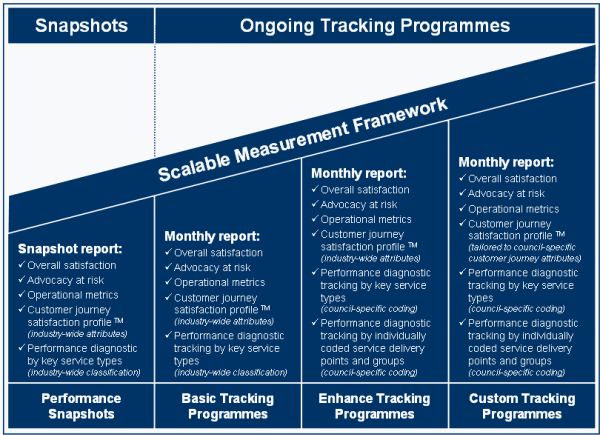
Scalable measurement framework
To
help meet this challenge, CTMA has established a scalable measurement
framework that provides local councils with a set of cost-effective and
easy-to-implement options, from one-off customer experience
snapshots - to a range of ongoing
customer experience tracking programmes, and
from standard industry-wide configurations to customised
council-specific solutions.
The framework helps to drive continuous improvement at the department
and customer touch-point level, and consists of a portfolio of
measurement solutions focused on specific council processes.
If you are interested in adopting this approach at your
local authority, please contact us
today to discuss the framework in more detail, get help in selecting the
participation level that’s right for your council and learn more about
how to change the local government customer experience management
paradigm.

 Customer experience snapshots
CTMA’s customer experience snapshots provide an initial, high-level,
external verification of service performance - for councils not yet
wishing to engage in an ongoing measurement programme. The
snapshots are based on the same condensed questionnaire format as CTMA’s
ongoing tracking programmes, but focus on providing a single report
summary of performance over a short, recent 2-3 month period.
Customer experience tracking programmes
CTMA has been working with individual councils since 2002 to develop
cost-effective management tools that provide an ongoing external
measurement of service effectiveness. These satisfaction tracking tools
help to monitor and support the ongoing management and service quality
improvement of specific customer processes such as
service requests, resource consents, and building consents.
CTMA’s satisfaction tracking programmes help individual councils
build cost-effective and customer-driven service standards and monitor
the effective completion of internal processes and outsourced tasks.
Industry-wide customer experience baseline
CTMA’s customer experience baseline study of
Building Consent and Inspection Services has demonstrated how
effective service can be directly linked to the industry's support for
building regulations and a region’s potential for growth.
The study helps participating councils identify opportunities for
improvement within their own organisations and make service improvement
investments that yield the most benefit to their customers. It helps to
identify where limited resources might be reallocated to address issues
that have greater impact on strategic outcomes.
Case study: Using satisfaction measurement to Improve Service and Reduce Costs
Responding to customers and actioning their requests for service is a mounting cost for local councils. Managing the process to produce a satisfactory outcome for both customer and council is becoming an increasing and costly challenge.
This case study looks at how some New Zealand councils
achieved incremental improvements by building the customer into
their service quality improvement programmes and have turned
satisfaction measurement into a source of management actions.

Working paper: Top-level findings from CTMA’s 2018 local
government customer experience snapshot study
At a time when local government is searching for ways to
reduce their costs and improve public outcomes, a snapshot study
of New Zealand local councils reveals that three key customer
experience metrics that differentiate council performance and
quantify the potential for saving costs and improving council
and public outcomes. This paper discusses these metrics and
explains how they can be used to identify potential improvement
opportunities to reduce costs, improve council efficiency,
effectiveness, and obtain better overall council and public
outcomes.